
Garantie Décennale Explained: France's 10-Year Builder's Warranty
Garantie décennale is France's mandatory 10-year builder's warranty. Our English guide explains cover, cost, penalties, and how to check a builder's attestation.
By Paul Bendzik, insurance broker · Updated: July 2026

In brief
The garantie décennale is France's mandatory ten-year liability, created by the loi Spinetta of 1978. Any builder working on French soil, French or foreign, must carry it before starting a job. It covers defects that threaten a structure's soundness or make it unusable. This guide explains what it covers, who needs it, the penalties for going without, and how to check a builder's insurance certificate.
At a glance
If you build or buy property in France, one insurance term follows you everywhere. It's the garantie décennale. In English it goes by several names: decennial liability, the ten-year builder's warranty, or simply assurance décennale. They all point to the same rule, and this DigiCare Insurance guide explains that rule in plain English. It's an explainer, not a quote page; for cover and pricing, see our guide to decennial insurance in France.
Two readers need it most. First, foreign builders and artisans, who must carry the cover before they lift a tool. Second, foreign owners, who must check that their builder actually holds it. We'll walk through what it protects, who needs it, the penalties for skipping it, and how to read a builder's certificate.
What is the garantie décennale (decennial liability) in France?
The garantie décennale (decennial liability, or ten-year builder's warranty) is France's mandatory ten-year cover for builders. Created by the loi Spinetta of 1978 and set out in Code civil article 1792, it makes a builder answerable for defects that threaten a structure's soundness or make it unfit to live in, for ten years after the works are accepted.
You'll see it written four ways: garantie décennale, decennial liability, ten-year builder's warranty, and assurance décennale (the policy itself). They mean the same thing. The rule dates back to the loi Spinetta of 1978, the law that built France's whole construction-insurance system.
Two tests decide whether a defect falls under it, and both come from Code civil article 1792. The first is "solidité", the structural soundness of the building. The second is "impropriété à destination", meaning the building can no longer be used for its purpose. Fail either test, and the builder is on the hook. The duty falls on the constructor: the entrepreneur, architect, engineer, or artisan who did the work. You can read the official summary on France's public-service site, service-public.gouv.fr. Internationally, this kind of cover is also called Inherent Defect Insurance.
Looking for the price of decennial insurance?
This guide explains the legal guarantee. For pricing and to take out cover, see our page on decennial insurance.
Who must carry decennial insurance, and does it apply to foreign builders?
Yes, it applies to foreign builders. Any builder working on French soil must carry decennial insurance, whatever their nationality or where their business is registered. The duty covers contractors, architects, engineers, artisans, and auto-entrepreneurs (self-employed micro-businesses). There's no exemption for small operators, and the cover must be active before the first day on site.
- 1Building firms and contractors of any size
- 2Architects and engineers who design or oversee the work
- 3Artisans such as masons, roofers, and electricians
- 4Auto-entrepreneurs and micro-entrepreneurs in the building trades, with no small-business exemption
- 5Foreign and expat builders carrying out works in France, regardless of where the company is based
The rule comes from Code des assurances article L241-1: anyone whose decennial liability can be engaged must be insured, and must prove it when the site opens. Subcontractors are a special case. A subcontractor generally isn't bound directly, because they have no direct contract with the client, but the main contractor's ten-year liability still runs. French-speaking builders can also read our garantie décennale French guide. If you're an English-speaking artisan setting up in France, here's the point I'd underline. The cover applies to works carried out in France, and it must be in force before your first chantier (building site). Not after the deposit clears. Before.
What does the garantie décennale cover, and what's excluded?
Decennial liability covers damage that undermines a building's structure or makes it unfit for its purpose. That includes foundations, load-bearing walls, the frame, and a roof that no longer keeps water out. It doesn't cover cosmetic flaws, normal wear, poor upkeep, or damage that someone else caused.
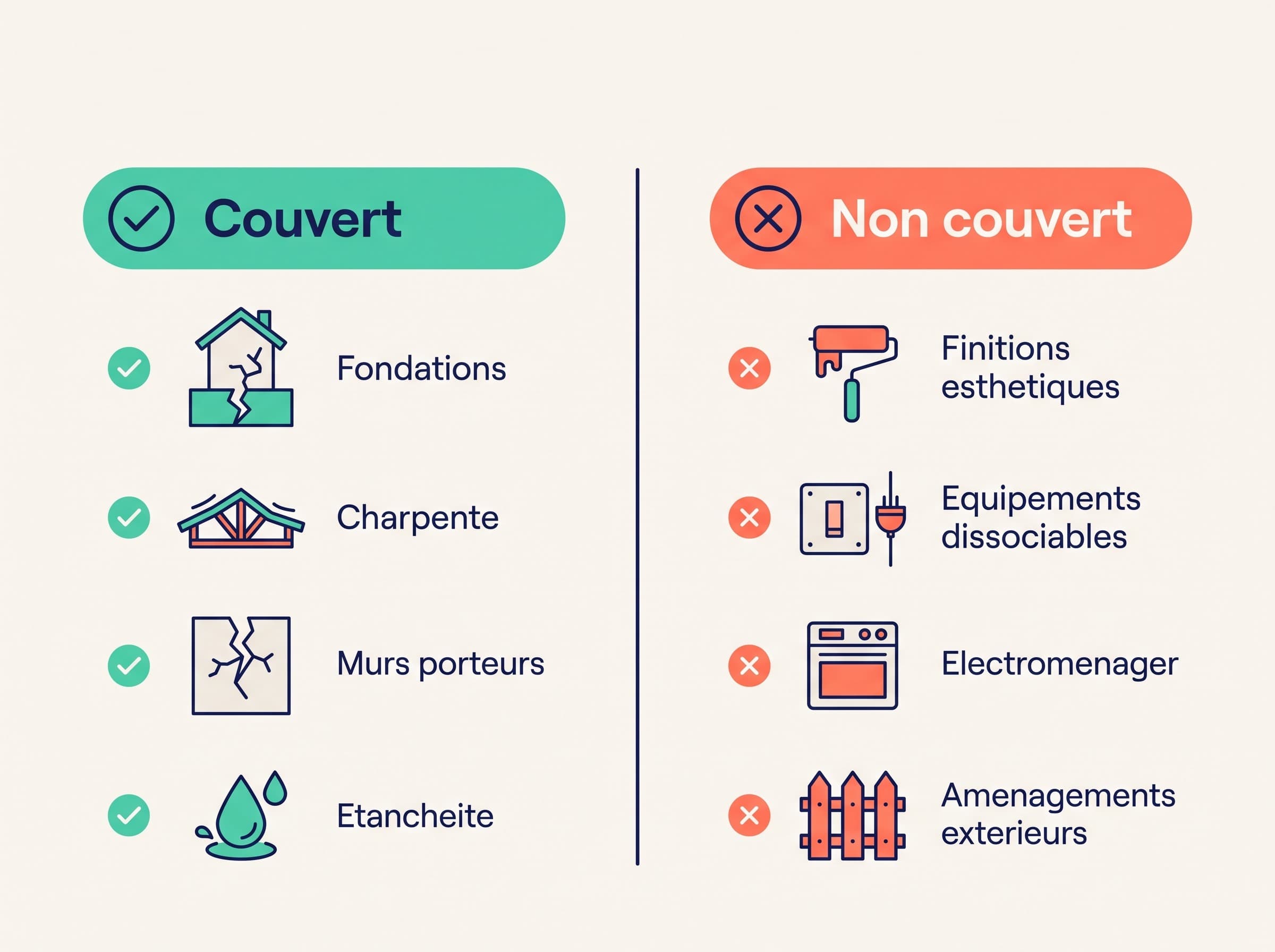
| Covered by the décennale | Not covered |
|---|---|
| Cracks or movement in foundations, load-bearing walls, or the frame | Cosmetic flaws (paint, marks, hairline cracks) |
| A roof that lets water in or fails to do its job | Normal wear and tear |
| Damage that makes the home unfit to live in | Poor upkeep or missed maintenance |
| Equipment built into the structure that can't be removed without damaging it | Damage caused by a third party |
| Inseparable equipment under Code civil art. 1792-2 | Equipment merely added to an existing building |
The scope of covered damage is set out on service-public.gouv.fr. One grey area is worth flagging. Recent rulings from the Cour de cassation have narrowed cover for equipment simply added to an existing building, such as a heat pump that isn't built into the structure. Those items can fall to ordinary contractual liability, with a shorter limitation period, instead of the ten-year guarantee.
What this means for owners
Don't assume every fault is a décennale claim. Structural and built-in problems usually qualify. Finishes, add-on kit, and things you failed to maintain usually don't.
The three post-completion guarantees: 1, 2 and 10 years
France gives an owner three separate guarantees after the works are accepted. They start on the same day but run for different lengths and cover different problems. Owners often claim under the wrong one.
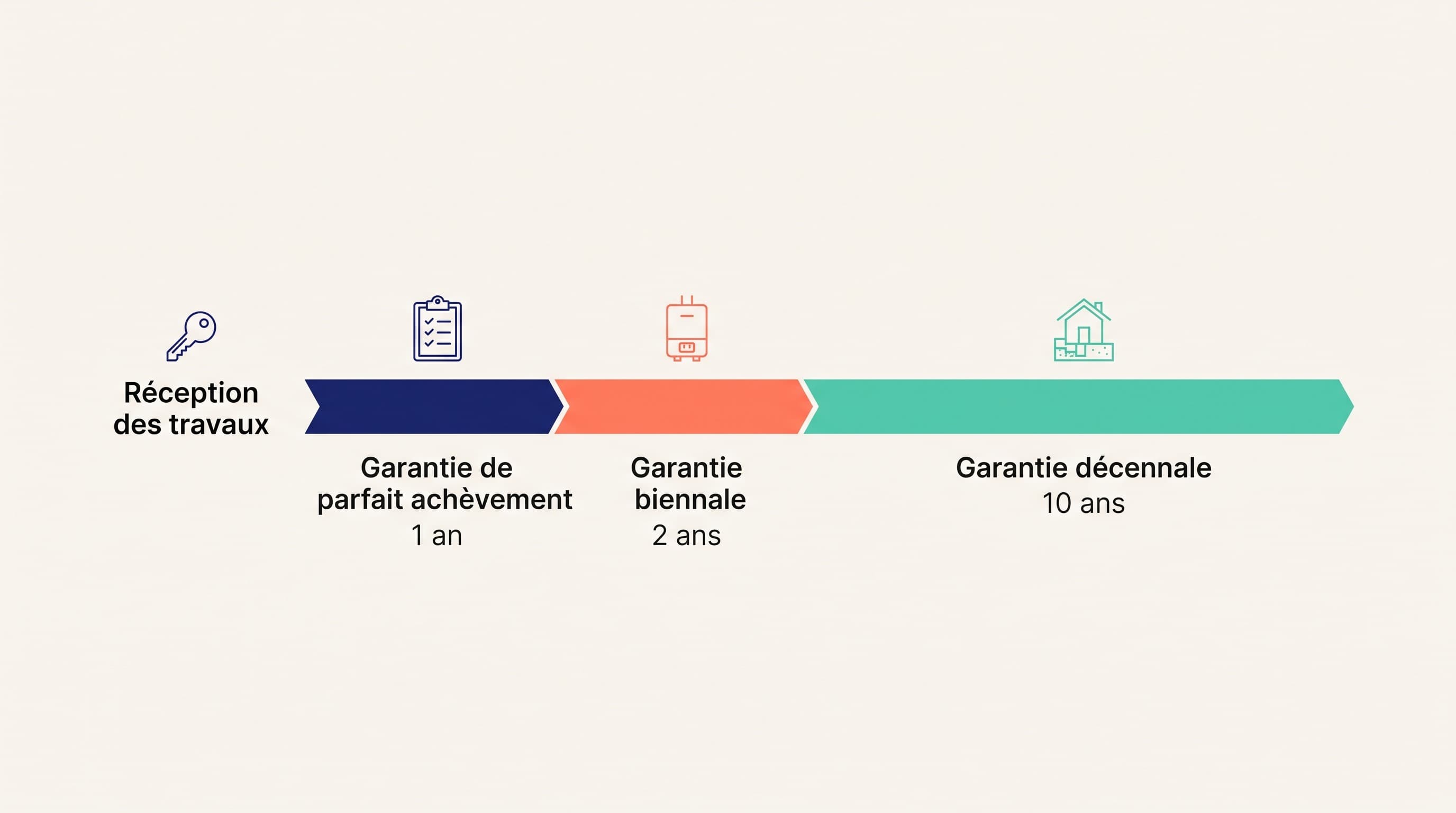
| Guarantee | Length | What it covers | Legal basis |
|---|---|---|---|
| Parfait achèvement (perfect completion) | 1 year | Every defect noted at handover or reported in the first year | Code civil art. 1792-6 |
| Biennale / bon fonctionnement (good working order) | 2 years | Removable equipment: taps, radiators, shutters | Code civil art. 1792-3 |
| Décennale (decennial) | 10 years | Structural damage and built-in equipment | Code civil art. 1792 |
All three run from the same réception date, the day the works are formally accepted. The routing question is simple. A cracked tile a few weeks after handover is usually a biennial or manufacturer matter. A structural crack in a wall is a décennale matter.
What this means for owners
Match the defect to the right guarantee before you write to anyone. A structural fault claimed as a two-year issue can be dismissed, and a minor fault claimed as a ten-year issue just wastes your time.
How long does it last, and when does the clock start?
The garantie décennale lasts ten years. The clock starts the day after the procès-verbal de réception (the acceptance report) is signed, under Code civil article 1792-4-1. A defect has to appear within those ten years to be claimable. Without a formal réception, there's no clean start date.
That last point is a common trap. If you never sign a proper acceptance report, the ten-year window has no firm beginning, which makes a later claim harder to pin down. So the réception isn't paperwork to skip. It's the moment that starts your protection. The official duration is confirmed on service-public.gouv.fr. And here's one thing owners rarely expect to hear as good news: the policy generally survives the builder's bankruptcy, so you can usually still claim on it if the firm has closed.
What happens if a builder has no décennale? Penalties and your risk
A builder who works without decennial insurance faces up to €75,000 and/or up to six months in prison, under Code des assurances article L243-3. For the owner, the bigger danger is financial. Hire an uninsured builder, and you could end up paying for structural repairs yourself.
There's one gap worth knowing. Self-builders (auto-constructeurs) putting up a building for their own family to live in are exempt from that criminal penalty, as the service-public.gouv.fr guidance confirms. They still carry the underlying civil liability, though, so the ten-year exposure doesn't disappear. And in practice, enforcement of the penalty can be uneven. That's a reason to protect yourself rather than lean on the threat of a fine.
What this means for owners
The penalty is really the builder's problem; the repair bill can become yours. Two moves cut that risk. Check the builder's certificate before you sign (see below), and consider dommages-ouvrage cover of your own. This is general guidance, not legal advice.
The attestation d'assurance décennale: the document to check before you hire
The attestation d'assurance décennale is the builder's insurance certificate. Before you sign a quote, check six things on it: the insurer, the policy number, the validity dates, the scope of cover, the geographic area, and the exact activities listed. Only the activities named on the certificate are actually covered.
- 1Insurer identity a named, real insurance company
- 2Policy number present and legible
- 3Validity period it must cover the dates of your works
- 4Scope of guarantee it says décennale, not just general liability
- 5Geographic area France, and ideally your region
- 6Declared activities your exact type of work is listed by name
That scope check catches the mistake I see expat owners make most. A builder hands over a smart-looking certificate, everyone relaxes, and nobody notices it's an RC pro (public liability) certificate, not a décennale one. The two are not interchangeable. RC pro covers day-to-day accidents on site; only the décennale covers a structural defect ten years later. Read the scope line, not just the letterhead.
The declared-activities line matters just as much. If your project is a roof and the certificate lists only tiling, the roof work may not be covered. The certificate must be handed over before the chantier opens, and under rules in force since 2016 it's attached to quotes (devis) and invoices. When you buy a property with an unexpired ten-year guarantee, the attestation is annexed to the deed of sale, which is useful for expat buyers checking what protection they inherit. You'll find the official rule on providing the certificate before works at service-public.gouv.fr.
Décennale vs dommages-ouvrage vs RC pro: who insures what?
These three covers protect different people. The garantie décennale is the builder's ten-year cover for structural defects. Dommages-ouvrage is the owner's policy that pays for repairs fast, before blame is settled. RC pro (professional indemnity) covers a professional's everyday third-party liability, and never replaces décennale.
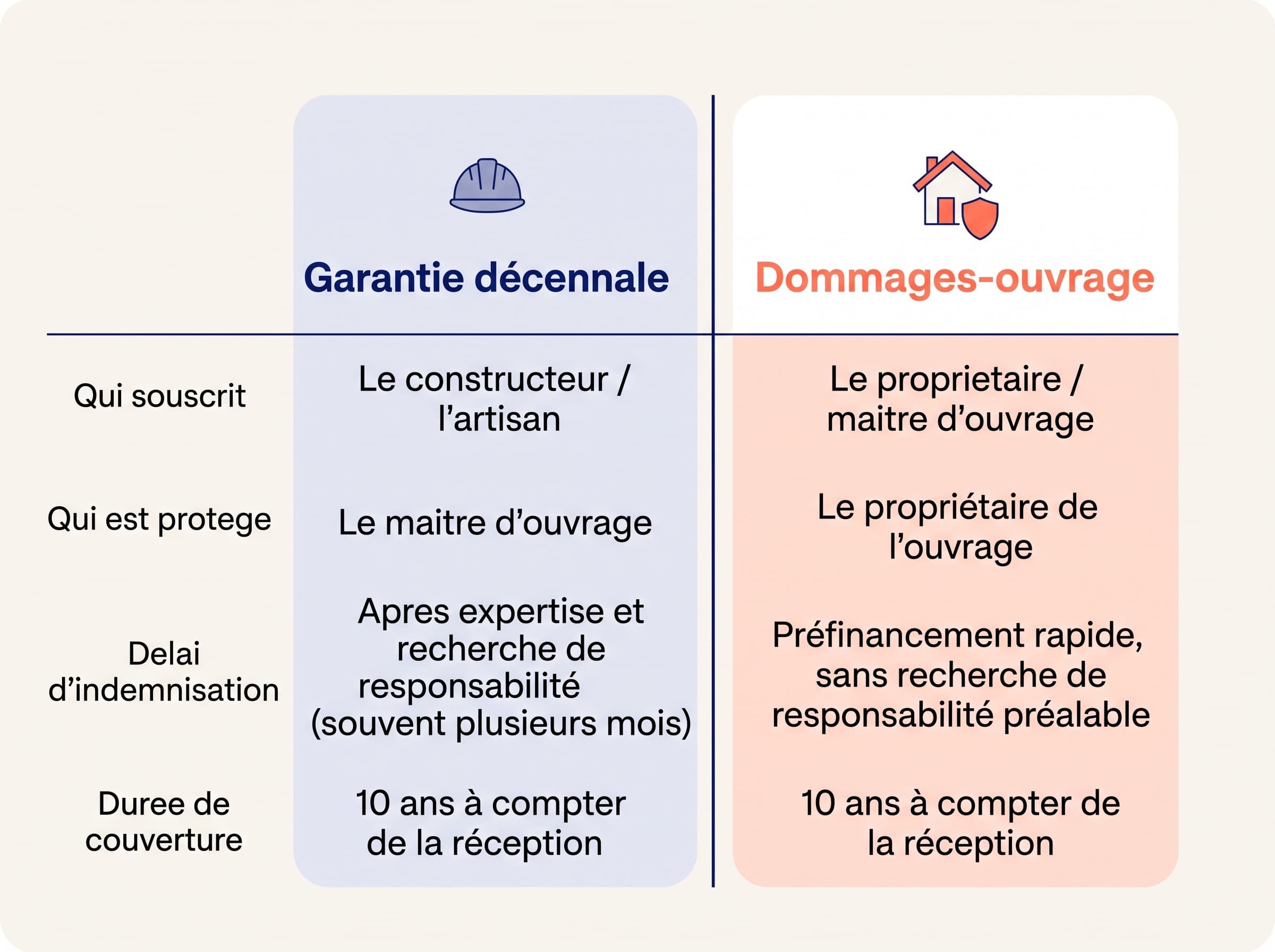
| Garantie décennale | Dommages-ouvrage | RC pro | |
|---|---|---|---|
| Who buys it | The builder | The owner (maître d'ouvrage) | The professional |
| What it does | Pays for structural defects for 10 years | Pre-funds repairs quickly, then recovers from the builder's insurer | Covers everyday third-party harm from the pro's work |
| Legal basis | Code civil art. 1792 | Code des assurances art. L242-1 | Contract-based; not a décennale substitute |
The décennale and dommages-ouvrage together form France's "double-trigger" system. The owner's policy pays for the repair straight away, then claims back from the builder's decennial insurer, so you aren't left waiting years for a court to decide who's at fault. RC pro is a different animal, and so is the personal "responsabilité civile" bundled into home insurance. Neither one stands in for décennale.
What this means for a building professional
You may need more than one policy. Read our guide to dommages-ouvrage insurance for the owner side, and professional indemnity / RC pro for third-party cover. For a décennale quote, use the decennial insurance pillar.
How to activate (faire jouer) the decennial guarantee, step by step
If a structural defect appears within the ten years, you activate the guarantee ("faire jouer la garantie"). The process is procedural, and doing it in order protects your claim.
- 1Document the defect. Take dated photos, keep the acceptance report, and note when the problem appeared.
- 2Write a registered letter. Send a lettre recommandée (formal registered notice) to the builder and to their insurer, naming the décennale.
- 3The insurer opens a claim. They register it and appoint an expert.
- 4The expert assesses. They examine the damage and decide whether it falls under the guarantee.
- 5Repair or compensation follows. If the claim is accepted, the insurer funds the fix. If it's refused, try mediation through the Médiateur de l'assurance before going to court.
If the builder has closed (entreprise fermée), contact the insurer directly using the attestation you kept. That's one more reason to file that certificate somewhere safe on day one. Owners who took out dommages-ouvrage can usually claim on that first for speed, and the insurer then recovers from the builder's décennale.
How much does decennial insurance cost in France?
Decennial insurance in France typically runs from a few hundred euros to around €8,000 a year, depending on the trade. A drywall installer might pay near €1,200, while a new-build construction SME can reach €8,000. These are indicative public figures, not DigiCare rates.
| Profile | Indicative yearly premium |
|---|---|
| Self-employed craftsman (e.g. drywall installer) | A few hundred euros up to ~€1,200 |
| New-build construction SME | Up to ~€8,000 |
| Owner's dommages-ouvrage (separate policy) | Several thousand euros |
Four things move the price: the risk band of the trade, annual turnover, the type of work, and claims history. A widely quoted international rule-of-thumb puts construction cover at around 1.5% of the structure's value, including the technical inspections France requires. The figures above are drawn from publicly available guides and are illustrative only.
What this means for builders
Treat these as a starting range, not a promise. Your actual premium depends on your trade and your record. For a real figure, get a décennale quote rather than working from a table.
In summary
The takeaway splits by who you are. If you build in France, carry decennial insurance before your first chantier, and list every activity on the certificate. If you own or buy, check the builder's attestation and think about dommages-ouvrage.
When you're ready, get a décennale quote, or read our dommages-ouvrage and professional indemnity guides. DigiCare is an independent broker; the French insurers behind these policies are supervised by the Autorité de contrôle prudentiel et de résolution (ACPR).
Frequently asked questions
Is the garantie décennale mandatory for a foreign builder working in France?
Yes. The duty attaches to any constructor carrying out covered works on French soil, whatever their nationality or where the business is registered. The cover must be in force before the building site opens. There's no exemption for small firms or auto-entrepreneurs.
What is the difference between garantie décennale and dommages-ouvrage?
The décennale is the builder's ten-year cover for structural defects, under Code civil article 1792. Dommages-ouvrage is the owner's policy, taken out before works under Code des assurances article L242-1, that pays for repairs fast and then recovers from the builder's insurer. Together they form France's "double-trigger" system.
How long does the garantie décennale last?
Ten years. The period starts the day after the procès-verbal de réception (the acceptance report) is signed, under Code civil article 1792-4-1. A defect has to appear within those ten years to be claimable, so a proper réception matters.
What does the décennale not cover?
It doesn't cover cosmetic defects, normal wear and tear, poor maintenance, or damage caused by a third party. Recent Cour de cassation rulings have also narrowed cover for equipment merely added to an existing building, such as a heat pump that isn't built into the structure.
What happens if my builder has no décennale?
The builder faces up to €75,000 and/or up to six months in prison under Code des assurances article L243-3. As the owner, you could have to fund structural repairs yourself. That's why you should verify the attestation before hiring and consider dommages-ouvrage cover.
How do I check a builder's attestation d'assurance décennale?
Check the insurer, the policy number, the validity dates, the scope, and the geographic area. Most important, confirm that your exact type of work is named on the certificate, because only the declared activities are covered. The certificate should be provided before the works begin.
How do I make a decennial-guarantee claim (faire jouer la décennale)?
Document the defect with dated evidence, then send a registered letter to the builder and their insurer naming the décennale. The insurer opens a claim and appoints an expert, who assesses the damage. If accepted, the insurer funds the repair; if refused, try mediation before court.
Need an attestation d'assurance décennale?
DigiCare Insurance, an independent broker supervised by the ACPR, compares contracts for you and helps you get your certificate before the chantier begins.