
Professional Indemnity Insurance for Architects in Germany: Registration, Minimum Sums & Cost
Professional indemnity insurance for architects in Germany is a condition of chamber registration, not a federal law. Minimum sums (€1.5m / €250k), the recognition path for foreign architects, and cost, explained by an independent broker.
By Paul Bendzik · Last updated: July 2026

The essentials at a glance
Architects in Germany must hold professional indemnity insurance (Berufshaftpflichtversicherung) to be entered in their federal state's register of architects (Architektenliste). It is a condition of chamber registration set by each state's architect law, not a single federal rule, so the minimum sum varies by Bundesland: typically €1.5 million for personal injury and €250,000 for property and financial damage per claim. Recognition of a foreign qualification under Directive 2005/36/EC is a separate, earlier step; insurance is required at the registration stage. Premiums usually run from about €500 to €10,000 a year.
At a glance
Architects practising in Germany must hold professional indemnity insurance (Berufshaftpflichtversicherung) to be entered in their federal state's register of architects (Architektenliste). It is a condition of chamber registration, not a nationwide federal law, and the minimum sum insured is set state by state, so the exact figure depends on where you register. This guide is written for foreign-qualified and EU-qualified architects, self-employed planners (Planer), engineering consultants, and firms opening a German branch (Niederlassung). It sits alongside our overview of professional liability insurance in Germany.
One promise before we start: every German term is glossed in English the first time it appears, because the paperwork you meet at the chamber is in German even when your policy and your adviser are not. We cover whether the cover is compulsory, how a foreign-qualified architect actually gets onto the register, why insurance is tied to registration, what the policy pays for, the minimum sums by state, and what it costs.
Is professional indemnity insurance mandatory for architects in Germany?
Yes, but not through a single federal law. Professional indemnity insurance (Berufshaftpflichtversicherung) is a condition of being entered in your federal state's register of architects (Architektenliste), set by each state's architect law (Architektengesetz) and enforced by the chamber of architects (Architektenkammer). Without it you cannot register, and losing it can cost you your registration.
That is why you see brokers say the cover is required by law while a general insurance page says it is not mandatory for everyone. Both are half right. For a registered architect who carries the protected title Architekt, the cover is effectively compulsory, because the chamber will not enter you on the register without it. For someone doing technical work without chamber registration, there is no such statutory duty. We tackle the broader question of whether professional indemnity insurance is mandatory in Germany in a separate guide; here we stay with the architect and engineer angle.
The practical takeaway is that, for architects, the duty to insure and the right to use the title are the same decision. Register with your chamber and you insure; drop the insurance and you put your registration at risk.
How foreign-qualified architects get entered in the Architektenliste
If you qualified as an architect elsewhere in the EU, the EEA, or Switzerland, your qualification enjoys automatic recognition in Germany under Directive 2005/36/EC. Recognition is the first step; entry in a federal state's register of architects (Architektenliste), where you prove your insurance, is a separate second step handled by the chamber of architects.
This is the part no English-language competitor spells out, and it is where most confusion starts. Keep the EU recognition step and the chamber registration step visibly apart, then work through them in order
- 1Recognition of your qualification architect is one of seven professions with automatic recognition under Directive 2005/36/EC, so an EU, EEA or Swiss architecture qualification is accepted without a fresh equivalence test.
- 2Apply to the chamber of the state where you will work you register with the Architektenkammer of that Bundesland, or use the electronic European Professional Card (EPC) route described on the EU's Your Europe portal.
- 3Expect a set timeline the chamber acknowledges your application within one month and decides within three months of receiving complete documents.
- 4Meet the local conditions the host state may ask for proof of German-language ability and chamber membership before it enters you on the list.
- 5Insurance enters here at the registration stage (Eintragung) you must show proof of professional indemnity insurance (Versicherungsnachweis). This is the moment the policy becomes a requirement, not at the earlier EU-recognition stage.
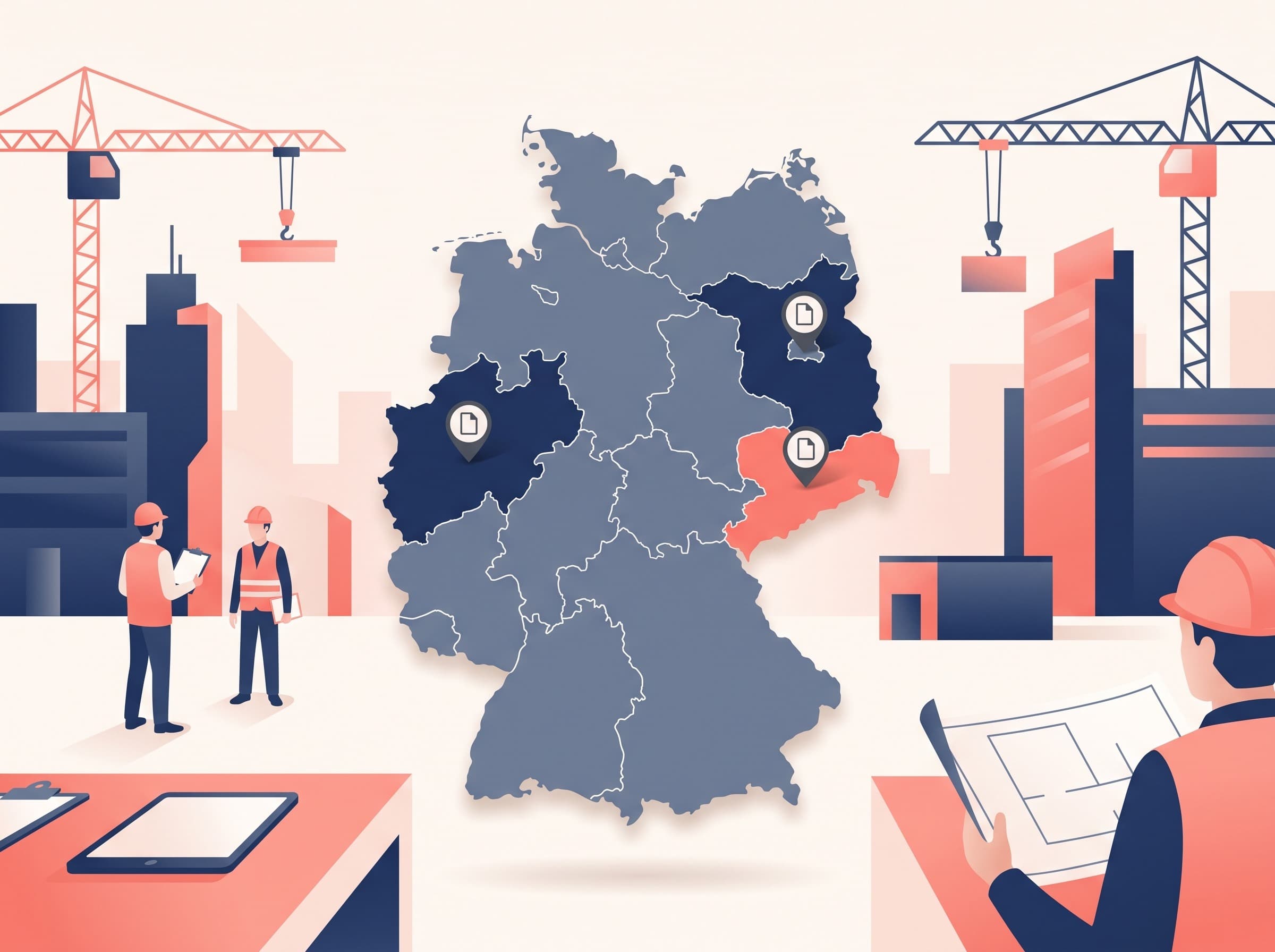
Qualifications from outside the EU and EEA are assessed under the general system, which can mean an equivalence check or an adaptation measure before entry. Brandenburg's one-stop portal (EAP Brandenburg) sets out the register path for EU, EEA and Swiss applicants in detail.
What this means for architects
Keep the two steps apart. EU recognition proves you are an architect; it does not require you to hold insurance. Chamber registration proves you may practise in that state, and that is where the insurance requirement bites. Sorting out cover before you file the registration paperwork removes the most common delay. For the broader, non-architect question of whether professional indemnity insurance is mandatory in Germany, see our dedicated guide.
Why insurance is a condition of registration, and the minimum sums by state
Each federal state's architect law (Architektengesetz) makes adequate professional indemnity insurance a condition of registration. In Baden-Württemberg and Hamburg the minimum is €1.5 million for personal injury (Personenschäden) and €250,000 for property and financial damage (Sach- und Vermögensschäden) per claim. Other states set higher annual aggregates.
The statutory hook is a clause such as § 17 Architektengesetz Baden-Württemberg, which sets adequate cover as an entry requirement (Eintragungsvoraussetzung). The chamber checks your proof of cover (Versicherungsnachweis) at registration and runs random inspections, often once a year. Letting cover lapse counts as professional misconduct and can lead to deletion from the register (Löschung aus der Architektenliste), which is the enforcement that gives the rule its teeth.
Because the duty sits in state law rather than one federal statute, the numbers move when you cross a state border. The table below sets out three representative states.
| Bundesland | Personal injury (per claim) | Property & financial (per claim) | Basis |
|---|---|---|---|
| Baden-Württemberg | €1.5 million | €250,000 | § 17 Architektengesetz Baden-Württemberg |
| Hamburg | €1.5 million | €250,000 | Hamburgisches Architektengesetz (AKHH) |
| Brandenburg | €1.5 million (€3 million annual aggregate) | €250,000 (€500,000 annual aggregate) | Brandenburgisches Architektengesetz (EAP Brandenburg) |
Table: minimum professional indemnity sums for architects in three German states. Brandenburg carries the same per-claim floor but a higher annual aggregate. Always confirm the current figure with the chamber where you register.
What this means for architects
€1.5 million and €250,000 are floors for an average risk, not a recommendation. If you work on large structural projects or high-value contracts, a higher sum insured (Versicherungssumme) is sensible, and it also shapes your premium, which we come to next. Confirm the current number with the chamber of the state where you register, for example Baden-Württemberg (AKBW), Hamburg (AKHH), or Lower Saxony (AKNDS).
How much does professional indemnity insurance cost for architects?
Architect professional indemnity premiums in Germany usually run from about €500 to €10,000 per year. The figure depends on your fee turnover, the sum insured and deductible you choose, the size and risk of your projects, and whether you insure annually (Jahresversicherung) or per project (Objektversicherung).
Two rating models sit behind that band. An annual policy (Jahresversicherung) covers all your work for a year and suits an office with a steady pipeline. A project policy (Objektversicherung) covers one named project from start to finish, which fits an architect who takes on occasional large commissions. Raising the sum insured toward the higher tiers the market offers (for example €3 million, €5 million, or €10 million) and taking on more structural or supervisory work both push the premium up.
What this means for architects
Treat the €500 to €10,000 range as a market band, not a quote: your own figure comes from your turnover and risk profile. The premium is a business expense (Betriebsausgabe) and is tax-deductible for a self-employed architect, which softens the real cost. As an independent broker, we put several insurers side by side rather than send you to a comparison calculator.
What professional indemnity insurance covers for architects
Professional indemnity insurance for architects is broad cover: it pays for personal injury, property damage, and the financial loss that follows from a professional mistake. Be wary of any product sold as covering pure financial loss only, because an architect's exposure runs across all three.
The architect-specific risks the market insures are best read as a list
- 1Planning errors (Planungsfehler) a design fault or miscalculation that has to be corrected or rebuilt.
- 2Construction-supervision errors (Bauüberwachungsfehler) defects that slip through on-site monitoring.
- 3Purely financial losses delays, cost overruns, or wrong quantity estimates that cost the client money without any physical damage.
- 4Copyright issues (Urheberrecht) claims that a design infringes another's protected work.
- 5Subcontractor and sub-planner liability mistakes by specialists you bring onto the project and co-insure.
- 6Third-party property damage and contractual penalties damage to others' property and agreed penalties arising from your work.
Two features the broker pages tend to underplay are worth naming. The first is defence of unjustified claims (passiver Rechtsschutz): if a client blames you for something that is not your fault, the insurer investigates and fights the claim at its own cost, in court if it has to. The second is run-off cover (Nachhaftung), which matters because building-defect claims surface late. Under § 634a of the German Civil Code (BGB) a client generally has five years to bring a defect claim, so cover that still responds to late claims protects you long after a project is signed off.
If your work is purely advisory and produces only financial loss with no building on the line, a dedicated financial-loss policy (Vermögensschadenhaftpflicht) may be the better fit. We cover that route on our professional liability insurance in Germany hub rather than here.
Annual cover or project cover? Choosing the right policy type
German architects insure in one of two ways, and the choice shapes both price and protection. An annual policy (Jahresversicherung) is the default for a working practice; a project policy (Objektversicherung) covers a single named building. Most established offices hold an annual policy and add project cover only for unusually large or long commissions.
An annual policy renews each year and covers every project you touch in that period, with the premium set mainly by your fee turnover. It is the simplest way to satisfy the chamber's continuous-cover requirement, because the register expects you to be insured for the whole time you are entered, not just while one job runs.
A project policy is tied to one building and typically runs for the construction period plus a run-off tail that reaches into the five-year defect-liability window under § 634a BGB. It suits a one-off large commission, a consortium project, or an architect who otherwise works abroad and takes a single German job. The trade-off is that it protects that project alone, so on its own it does not meet the chamber's requirement to stay insured across your whole registration.
What this means for architects
If you are registering to run a German practice, start with an annual policy so your cover never lapses and your registration stays safe. Add a project policy on top only when a single commission is large enough to warrant its own, higher limit.
Architects and engineers: the Ingenieurkammer parallel
Engineers who hold a protected title such as consulting engineer (Beratender Ingenieur) follow a parallel system. They register with the chamber of engineers (Ingenieurkammer) of their federal state under a state engineer law, with the same logic that insurance is a condition of registration and with their own minimum sums.
Architects and engineers routinely work on the same building and, when something goes wrong, can be held jointly and severally liable (gesamtschuldnerische Haftung), meaning a client can pursue any one party for the whole loss. That is one reason project cover insuring every party on a scheme is common on larger jobs. The Bundesingenieurkammer (BIngK) is the umbrella body for the state chambers of engineers.
An engineer doing purely advisory work with no building on the line faces the same financial-loss question an advisory architect does, and the same answer: a financial-loss policy (Vermögensschadenhaftpflicht) via our hub may fit better than a standard build-focused policy. Engineers searching for freelance (freiberufler) cover will find the same registration-and-insurance rule applies to them.
Choosing English-speaking cover: the DigiCare approach
For a foreign-qualified architect, the right policy is one you can read and manage in your own language while it still satisfies a German chamber. DigiCare is an independent insurance broker (Versicherungsmakler) that arranges professional indemnity cover for English-speaking architects and engineers, with English-language policy documents and advice.
Being independent means we compare several insurers rather than sell one provider's product, and we help you produce the proof of cover (Versicherungsnachweis) your chamber asks for at registration. On supervision, one point is worth stating plainly: DigiCare as a broker is registered under § 34d of the German Trade Regulation Act (Gewerbeordnung) and supervised by the Chamber of Industry and Commerce (IHK), while BaFin supervises the insurers themselves. We are not a price-comparison calculator (Vergleichsrechner); we advise.
It also helps to know where this cover sits among your other policies. Professional indemnity insurance answers for your professional mistakes; a business liability policy (Betriebshaftpflicht) answers for everyday accidents, such as a visitor injured in your office, and is separate and voluntary. For the full picture, see our guide to professional liability insurance in Germany.
Conclusion
For architects in Germany, professional indemnity insurance is not optional dressing; it is the condition that lets you onto your state's register of architects and keeps you there. Three points are worth remembering. The duty sits in state law and the chamber, not in one federal statute, so the minimum sum varies by Bundesland (€1.5 million for personal injury and €250,000 for property and financial damage per claim in Baden-Württemberg and Hamburg). EU recognition and chamber registration are two separate steps, and insurance enters at the second one. And letting cover lapse can cost you your registration, not just a claim.
Get the cover right and you swap an open-ended liability for a planned, deductible annual premium. For the full overview of your options, see our page on professional liability insurance in Germany, where you can request a no-obligation quote and speak to an independent broker in English.
Frequently asked questions about architect professional indemnity insurance
Is professional indemnity insurance mandatory for architects in Germany?
Yes, as a chamber requirement rather than a nationwide federal law. Professional indemnity insurance is a condition of being entered in your federal state's register of architects (Architektenliste), set by each state's architect law and enforced by the chamber of architects. The exact rule and minimum sum vary by Bundesland.
Do foreign-qualified architects need it to register?
Yes. Proof of professional indemnity insurance (Versicherungsnachweis) is required at the registration stage (Eintragung). Recognition of your qualification under Directive 2005/36/EC is a separate, earlier step and does not itself require insurance; the insurance condition applies when the chamber enters you on the register.
What is the minimum insurance sum for architects?
In Baden-Württemberg and Hamburg the minimum is €1.5 million for personal injury and €250,000 for property and financial damage per claim. Other states, such as Brandenburg, keep the same per-claim floor but set a higher annual aggregate. The figure is fixed by your chamber, so confirm it for the state where you register.
Does an employed (angestellter) architect need their own policy?
Usually not for their salaried work, because the employer generally carries the liability under § 619a BGB. You do need your own cover if you take on self-employed work on the side or hold a management role that carries personal responsibility. Check your position with your chamber before you rely on an employer's policy.
Are engineers covered by the same rules?
Engineers follow a parallel system through the chamber of engineers (Ingenieurkammer) and a state engineer law, with the same insurance-as-registration logic and their own minimum sums. Because architects and engineers often share liability on the same project (gesamtschuldnerische Haftung), project cover insuring every party is common on larger jobs.
How much does it cost per year?
Roughly €500 to €10,000 per year, depending on your fee turnover, the sum insured and deductible, project size and risk, and whether you insure annually (Jahresversicherung) or per project (Objektversicherung). Treat that as a market band; your own premium comes from your turnover and risk profile.
Free initial consultation with DigiCare
DigiCare is an independent insurance broker under § 34d of the German Trade Regulation Act (Gewerbeordnung), registered and supervised by the responsible Chamber of Industry and Commerce (IHK). You get a named point of contact and advice in German, English and Turkish.